
At a brief ceremony, Indonesian President Joko Widodo handed over the G20 presidency to Prime Minister Modi at the conclusion of the two-day G20 Summit in Bali.

In recent years, China and Russia have pushed for de-dollarisation within BRICS, which India has resisted. One reason is that India does not want to hurt its relationship with the United States, and another is the fear of China controlling trade because the renminbi is considered the strongest currency in the bloc today.

The prime minister will leave for the Indonesian city of Bali on Monday on a three-day visit to attend the summit that is expected to deliberate extensively on pressing global challenges including the Ukraine conflict and its implications.

Indian boxers have delivered their best-ever performance at a single edition of the Commonwealth Games, securing a record seven gold medals in Glasgow, surpassing their previous best of three golds.
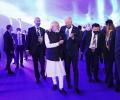
Prime Minister Narendra Modi will visit the Indonesian city of Bali from November 14 to 16 to attend the G-20 summit, the ministry of external affairs announced on Thursday.

Prime Minister Narendra Modi arrived in Bali on Monday for the G20 Summit and bilateral meetings on its sidelines with key leaders attending this annual conference of the world's major economies.

In a statement ahead of his visit to the Indonesian city for the G20 leaders' summit, Modi said he will also highlight India's achievements and its 'unwavering commitment' to collectively address key global issues.
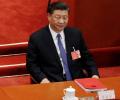
President Xi is also skipping the ASEAN (Association of Southeast Asian Nations) and East Asia summits in Jakarta this week.

At a media briefing, French President Emmanuel Macron said the G20 leaders' declaration "confirms" Russia's isolation for its attack on Ukraine and that the bloc is committed to "just and lasting" peace in the war-torn country.

There is no official word either from China or from India on who will represent Beijing at the upcoming G20 summit.

Prime Minister Narendra Modi on Tuesday asserted that there is a "huge difference" between pre- and post-2014 India, saying the country is now moving ahead at an "unprecedented speed and scale" as he showcased the achievements of his term in power to the Indian diaspora in Indonesia.
Two days ago, the Chinese foreign ministry following a meeting between NSA Ajit Doval and top Chinese diplomat Wang Yi in Johannesburg claimed that Xi and Modi had reached an 'important consensus' on stabilising bilateral ties at the interaction on the margins of the G20 Summit last November.

Prime Minister Manmohan Singh on Thursday embarked on a four-day visit to Indonesia and Singapore with an aim of bolstering partnership with East Asia at a time when the United States and Europe are going through economic crisis.

Glimpses from Prime Minister Narendra Modi's visit to Bali to attend the G20 summit on Monday, November 14, 2022.

India is awaiting a written confirmation from China on President Xi's participation in the G20 Leaders Summit, Muktesh Pardeshi, Special Secretary for G20, said on Friday.

India's dream to be in the forefront of international politics has come true. India has placed itself firmly as a major player in the shaping of a new world order, observes Ambassador T P Sreenivasan.

Modi on the global stage always comes across as a statesman, counselling peace and amity to world leaders even as his policies at home hurt certain sections, explains Virendra Kapoor.

It was a combination of Prime Minister Narendra Modi's 'guarantee and magic', the sources said while referring to total unanimity among member nations on the entire New Delhi G20 leaders' declaration.

Russian Foreign Minister Sergey Lavrov, who was representing President Vladimir Putin, left Bali on Wednesday, a day ahead of the scheduled conclusion of the G20 Summit held amid the economic challenges triggered by the Russia-Ukraine war.
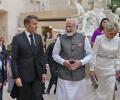
The Ukraine conflict and Chinese activities in the Indo-Pacific region figured in last week's talks between Prime Minister Narendra Modi and French President Emmanuel Macron, and both sides have similar views over the two issues, sources said on Monday.

The brief interaction between the two leaders comes ahead of Modi's first state visit to the US next month.
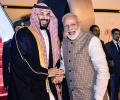
India is upset at a reference to Prime Minister Narendra Modi by a US state department official while defending the immunity it had extended to Saudi Arabian ruler Mohammad bin Sultan, who is facing allegations of killing journalist Jamal Khashoggi.
India and China may not be the antagonists everyone says they are, fighting for the same piece of pie, but nor are they the best of friends. Unlike, say, the United States and India which have discovered each other after a long period of standoffishness.

The New Delhi G20 Declaration refers only to the "war in Ukraine" and noted with "deep concern the immense human suffering and the adverse impact of wars and conflicts around the world."

China has signalled that it will prevent India from assuming leadership of the Global South, observes Ambassador T P Sreenivasan.
Prime Minister Manmohan Singh concluded his three-day visit to Bali on Saturday, where he attended the India-ASEAN meet and East Asia Summit, besides holding talks with US President Barack Obama and his Chinese counterpart Wen Jiabao.

If the meeting takes place, then it will be the first one between the two leaders after the Russian invasion of Ukraine in February last year.

"Have just got the good news that due to the hard work of our teams and your cooperation, a consensus has been reached on New Delhi G20 Leaders Summit Declaration," Modi said while addressing the second session of the Summit at the Bharat Mandapam in New Delhi.
The G20 declaration, which hit snags on the language to describe the Ukraine war, amounted to a 'coup' for host Prime Minister Narendra Modi though the final compromise statement reflected a stand far softer than those the United States and its Western allies have adopted on Russia, the world media said on Sunday.

The members of the grouping made it clear that they were against the use or threat of use of nuclear weapons and sought "peaceful resolution of conflicts."
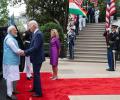
The change of heart in the US and India was propelled by the increased threat of China to both countries, explains Ambassador T P Sreenivasan.
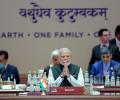
With consensus eluding on the paragraph relating to the Ukraine conflict, India on Friday circulated a draft summit declaration among the member countries without the paragraph on the geopolitical issue in an attempt to hammer out a positive outcome.

It was a tough negotiation and the consensus on the declaration was a great achievement by India, European sources said on the condition of anonymity.

The Asean secretariat hopes the meet may be able to iron out existing wrinkles raised by India. Since there had been no significant progress on the matter over the past two years on most issues, New Delhi is yet to decide on the invite.

Prime Minister Narendra Modi had informal interactions with US President Joe Biden, UK Prime Minister Rishi Sunak, French President Emmanuel Macron and several other global leaders on Tuesday on the sidelines of the G20 summit in Bali and exchanged views on a range of issues.

Being with Russia means being on the wrong side of history and Kyiv wants closer and deeper relations with New Delhi, Ukraine's First Deputy Foreign Minister Emine Dzhaparova said on Tuesday while suggesting that the Russian invasion has lessons for countries with 'difficult neighbours'.

Foreign Secretary Vinay Kwatra on Wednesday refused to speculate on whether the G20 foreign ministers' meeting would be able to come out with a joint communique against the backdrop of widening differences between the West and Russia on the Ukraine conflict.

In his monthly Mann Ki Baat radio broadcast, Modi also said that India is fully prepared for the G20 leaders summit, and heads of 40 countries and many global organisations are coming to Delhi to participate in the event.

The minister said this underlying resentment and pain of those countries regarding the global economy was building up for the last 15-20 years and the COVID-19 pandemic and the Ukraine conflict resulted in prices of energy and food items going up.
